


Final Tax Review: Six Decisions to Consider Before Year-End
“In this world nothing can be said to be certain, except death and taxes.” — Benjamin Franklin
While taxes may be unavoidable, paying more than necessary isn't inevitable. As 2026 comes to a close, reviewing your finances can reveal opportunities to manage your tax bill, plan for retirement, and keep more of your money working toward your goals. [full check list at the end of this article]
First, Understand Your Tax Bracket
Your taxes involve more than your total income. Taxable income is the amount of income subject to tax after applicable deductions. Ordinary income—including wages, traditional retirement account withdrawals, and Roth conversions—is generally taxed at graduated federal rates. Capital gainsare taxed differently, while deductions, credits, and income-based thresholds also affect your tax bill.
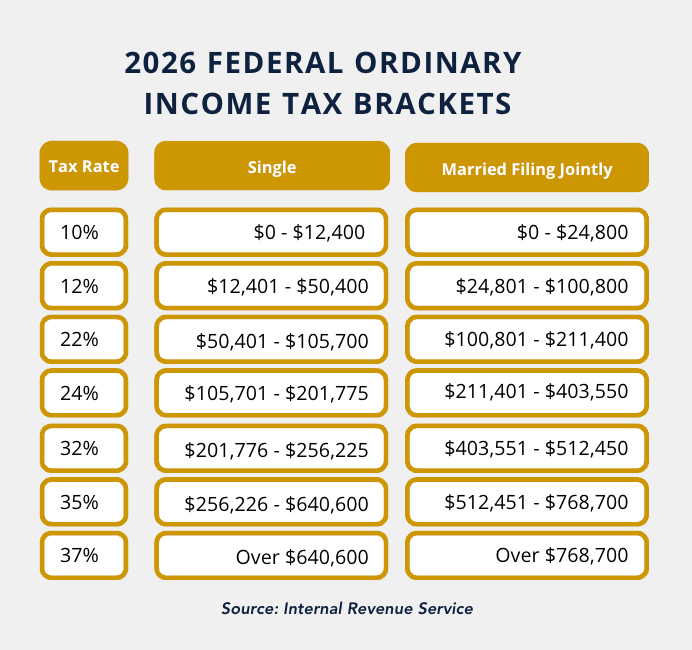
These rates apply to taxable income, not total household income. Each rate applies only to the portion of income within that bracket.
Second, Understand Your Tax Opportunities
1. Charitable Giving: Make Your Donations Tax-Efficient
What it is: Two strategies to consider are Qualified Charitable Distributions (QCDs) and donations in kind (DIKs), such as donating appreciated stocks directly to charity.
Who qualifies: A QCD is available to individuals age 70½ or older who donate directly from an eligible IRA to a qualifying charity. (note: QCDs are not allowed from employer retirement plans) The 2026 annual limit is $111,000 per individual.² A DIK can be made by an eligible donor of any age who owns assets a charity is willing to accept, including appreciated securities held in a taxable investment account.³
Deadline: Complete the transfer by December 31, 2026. QCD funds must go directly from the IRA custodian to the charity. Allow enough time for donated securities to reach the charity.
Who benefits / quick tip: QCDs can satisfy some or all of an RMD and are not included as a taxable distribution on your tax return. Donating appreciated securities may avoid capital gains tax on the appreciated asset and may qualify for a charitable deduction, subject to IRS rules. Unlike a QCD, a DIK does not automatically reduce taxable income dollar for dollar.
2. Roth Conversions: Decide When to Pay Taxes
What it is: Traditional retirement accounts generally offer tax-deferred growth, with withdrawals taxed as ordinary income at distribution. Roth accounts are funded with after-tax dollars, and qualified withdrawals are generally tax-free. Converting traditional retirement assets to a Roth account triggers tax on the amount converted.⁴
Who qualifies: Owners of eligible traditional IRAs and certain employer retirement accounts, subject to plan rules.
Deadline: December 31, 2026, for a conversion to count toward 2026 income.
Who benefits / quick tip: Consider whether paying tax today could be more advantageous than paying tax later. Your actual tax depends on your full circumstances. Ask your advisor to model the impact on your tax bracket, Medicare premiums, and other income-based thresholds before converting.
3. Required Minimum Distributions (RMDs): Avoid a Missed Withdrawal
What it is: RMDs are required minimum withdrawals required from most traditional IRAs and many employer retirement accounts. These withdrawals are generally taxable as ordinary income. Missing an RMD can trigger an additional tax, generally 25% of the shortfall, potentially reduced to 10% if corrected within the applicable correction window. ⁵ It’s best to avoid the penalty all together … be prepared to take your RMDs as soon as you are eligible.
Who qualifies: Most traditional retirement account owners must begin RMDs at the applicable age. Original owners of Roth IRAs do not have lifetime RMDs.
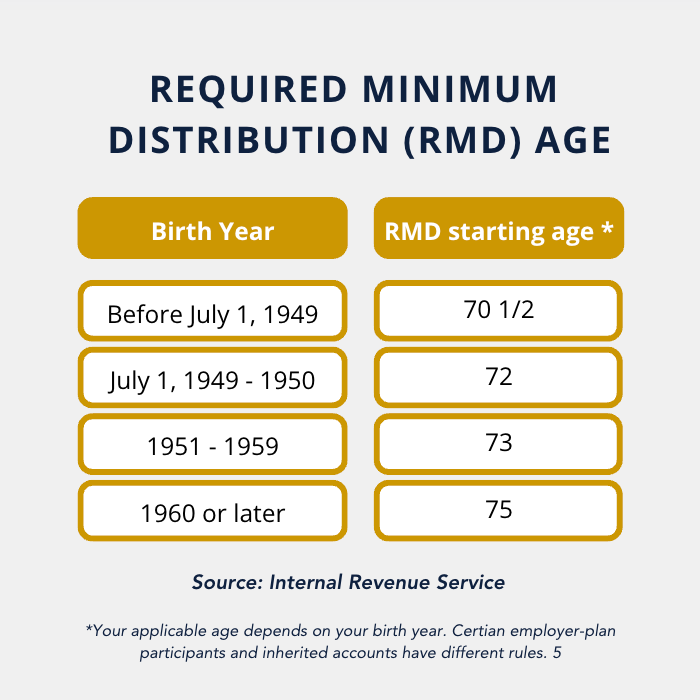
Deadline: 2026 RMDs must be taken by December 31, 2026. Your first RMD may be delayed until April 1 of the following year, but a second RMD will then also be due by December 31 of that year. ⁵ In most cases it is best to take the first RMD in the first year instead of delaying, to avoid having two RMDs in the same year. However, discuss with your financial advisor to see what your unique circumstance requires.
Who benefits / quick tip: Anyone approaching or past their RMD age should confirm the amount due with their account custodian. Charitably inclined retirees should ask whether a QCD could satisfy some or all their RMD.
4. Tax-Loss Harvesting: Put Investment Losses to Work
What it is: Selling investments at a loss can offset capital gains realized elsewhere in your taxable portfolio. If losses exceed gains, you may generally deduct up to $3,000 of net capital losses against ordinary income annually ($1,500 if married filing separately). Eligible unused losses can generally carry forward. ⁶
Who qualifies: Investors holding investments in taxable accounts.
Deadline: Complete eligible sales by December 31, 2026, for them to generally count toward the 2026 tax year.
Who benefits / quick tip: Understand the wash-sale rule before selling. If you sell an investment at a loss and buy the same or a substantially identical investment within 30 days before or after the sale, the loss is generally disallowed for the current deduction. The rule can also apply to purchases by your spouse or in your IRA. ⁶ Coordinate any replacement investment with your advisor.
5. Gifting: Transfer Wealth During Your Lifetime
What it is: Gifting allows you to transfer money or other assets to family members or others while you are alive.
Who qualifies: Anyone can make gifts, subject to applicable tax rules.
Deadline: Gifts generally must be completed by December 31, 2026, to qualify for the 2026 annual exclusion.
Who benefits / quick tip: The 2026 annual gift tax exclusion is $19,000 per recipient, per donor. A married couple may generally give a combined $38,000 per recipient. ⁷ Gifts generally do not reduce income taxes but can help transfer wealth and potentially reduce your future taxable estate. Larger gifts may require a gift tax return without necessarily creating gift tax due.
6. Retirement Contributions: Check Your Limits
What it is: Retirement contributions can affect your current taxes and future retirement income. Traditional contributions may reduce current taxable income if deductible or made through an eligible pre-tax plan; Roth contributions are made with after-tax dollars. ⁸
Who qualifies: Eligibility and deductibility depend on your account type, earned income, age, income, and workplace retirement coverage.
Deadline: Workplace plan contributions generally must be made through payroll by December 31, 2026. Eligible IRA contributions for 2026 can generally be made until April 15, 2027.⁹
Who benefits / quick tip: The 2026 employee contribution limit for 401(k), 403(b), Thrift Savings Plans, and governmental 457 plans is $24,500, with additional catch-up contributions for eligible participants. Employees 50 and older can contribute an additional $8,000 and employees age 60-63 can contribute an additional $11,250. The IRA contribution limit is $7,500, or $8,600 for those age 50 or older. ⁸ Check your year-to-date contributions and eligibility before contributing more.
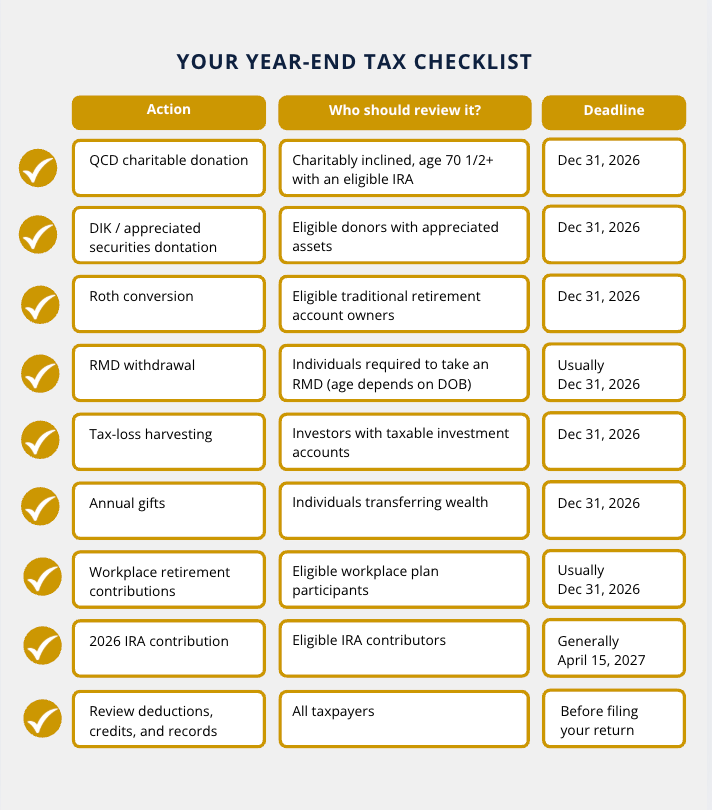
The bottom line: Not every strategy is right for every person, and some decisions can affect multiple parts of your tax picture. Review your options now, identify which deadlines apply to you, and speak with your financial advisor and tax professional before making significant changes. A little planning today can help keep more of your money working toward tomorrow's goals.
_____________________________________________________________________________________________
Official Resources
- 2026 federal tax brackets:IRS — Working Families Tax Cuts: Individuals and Workers
- QCD rules and limits:IRS — Publication 590-B, Distributions from Individual Retirement Arrangements
- Charitable gifts and deductions:IRS — Charitable Contribution Deductions
- Traditional and Roth IRA rules:IRS — Saving for Retirement: IRAs
- RMD ages, deadlines, and penalties:IRS — Required Minimum Distribution FAQs
- Capital losses and wash-sale rules:IRS — Topic No. 409, Capital Gains and Losses and Publication 550, Investment Income and Expenses
- Gift tax exclusions:IRS — Frequently Asked Questions on Gift Taxes
- 2026 retirement contribution limits:IRS — 401(k) and Profit-Sharing Plan Contribution Limits and IRA Contribution Limits
- Tax filing deadlines:IRS — When to File
This article provides general U.S. federal tax education, not individualized tax or investment advice. Readers should confirm how current rules apply to their circumstances with a qualified tax professional.